National Financial Educator Standards and Financial Literacy Standards in ANZ Region

Elevating Educator Capacity to Drive Financial Literacy Success

The NFEC created the first and only comprehensive standards designed specifically to help financial educators elevate the quality and impact of financial literacy instruction across the ANZ region. These standards outline what a financial educator should know, understand, and be able to teach across all core areas of personal finance, along with the proven best practices that lead to meaningful learning and long term behavior change.

Our goal was simple: make high quality financial literacy standards publicly available so educators, organizations, and communities have a clear roadmap for strengthening financial capability and improving long term outcomes. These standards remain the only recognized benchmark for ANZ based financial educators.

Research consistently shows that learners taught by qualified instructors experience stronger retention, higher lifetime earnings, greater retirement security, and improved overall well being. In short, highly qualified educators help people achieve better financial – and personal – outcomes.

Accredited. Independent. Trusted.

As the only Accredited Provider in the financial education space to establish industry standards for educators in the ANZ region, the NFEC sets the bar for excellence in personal finance instruction. Our framework is built on evidence‑based best practices, including:

  • Instructional design grounded in real‑world application
  • Learner‑centered methods that drive engagement and retention
  • Measurable outcomes that demonstrate true impact
  • Professional ethics that protect learners and organizations

This structure gives organizations confidence in the quality of instruction and ensures that learners receive education that genuinely supports their financial well‑being.

Crucially, the NFEC developed these standards independently – free from sponsorships, commercial influence, or outside funding. That independence ensures that the standards remain focused solely on what works: clear, defensible guidance that leads to measurable improvements for learners, employers, and communities.
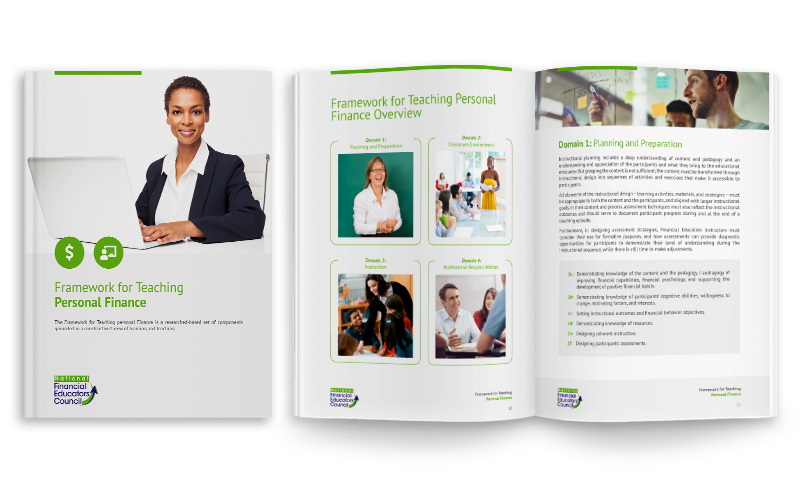
Standards for Financial Education Practitioners – Framework for Teaching Personal Finance

The NFEC developed the Framework for Teaching Personal Finance, the first and only international industry standards for financial education instructors. The Framework sets clear, practical benchmarks that help educators teach for greater impact and arm students with real-world financial skills.

Created with the Danielson Group and a multidisciplinary team spanning education, psychology, finance, and program evaluation, the Framework is aligned with InTASC core teaching standards. Adapting Charlotte Danielson’s model for financial literacy and grounded in constructivist learning, it defines 22 evidence-based components that specify the knowledge, competencies, and observable practices instructors must demonstrate. The Framework provides a roadmap of instructional practices linked with measurable participant gains.

Research-driven and widely accepted by educators, administrators, and policymakers, the Danielson Framework teaching model is adopted by more than 20 U.S. states and well-recognized worldwide. The NFEC’s adaptation brings the same rigor to financial education, delivering a defensible, standards-driven approach that enhances instruction and accurately tracks learner outcomes.

Certification Tour, Graduate Features, & Bonus Presentation Resources

  • CFEI® Tour: See how the program works and explore the journey step by step.

  • Graduate Features: Hear real stories from instructors making an impact.

  • Bonus Resources: Get exclusive teaching tools to elevate your financial education programs.

This is more than a course – it’s your opportunity to join a global network of educators committed to empowering individuals and communities with practical, life-changing financial skills.

By accessing the NFEC’s material, you agree to comply with the full terms.

Join Over 5,000 Enrolled CFEI® Champions Providing Others Qualified Financial Education

The NFEC Provides Standards for Financial Educators – The Groups Below Provide Standards for Learners

NFEC educator standards work in tandem with student learning standards by ensuring that instructors are equipped to deliver content that aligns with defined financial competencies and measurable outcomes. Together, they create a complete system where teaching quality and learner achievement are directly connected.

National Financial Capability Strategy (formerly National Financial Literacy Strategy)

Australia

Lead organization:
Australian Securities and Investments Commission (ASIC) / Australian Government Treasury

Description:

Australia’s national framework for improving financial capability and financial literacy. While not legislation, it operates as a national financial education standards framework, guiding schools, government agencies, employers, and community organisations. The strategy supports consistent financial literacy goals, consumer protection, and curriculum integration through the MoneySmart program.

Australian Securities and Investments Commission Act 2001 (ASIC Act)

Australia

Lead organization:
Australian Securities and Investments Commission

Description:
A foundational law empowering ASIC to promote informed financial participation and consumer protection. Although not a dedicated financial education law, it provides the legislative basis supporting national financial literacy initiatives and public financial education programs.

MoneySmart Teaching Program Standards

Australia

Lead organization:
Australian Securities and Investments Commission

Description:
A nationally aligned educational framework integrating personal finance into school learning. The program supports teachers with curriculum-linked resources and practical learning outcomes, helping establish de facto financial literacy standards in Australian schools.

Australian Curriculum – Consumer and Financial Literacy Capability

Australia

Lead organization:
Australian Curriculum, Assessment and Reporting Authority (ACARA)

Description:
The national curriculum embeds consumer and financial literacy capabilities across year levels. While not standalone legislation, it serves as an important national benchmark for financial education standards in formal schooling.

The New Zealand Curriculum – Financial Capability Framework

New Zealand

Lead organization:
Ministry of Education

Description:
New Zealand integrates financial capability into the national curriculum as a cross-disciplinary learning theme. This framework establishes practical expectations for money management, budgeting, and decision-making, functioning as a national financial education standards model for schools.

Financial Capability Progressions

New Zealand

Lead organization:
Ministry of Education

Description:
A curriculum-aligned framework outlining age-appropriate financial learning outcomes from Levels 1-8. These progressions help schools apply consistent financial literacy standards and embed personal finance education throughout classroom instruction.

NZQA Financial Capability Assessment Standards

New Zealand

Lead organization:
New Zealand Qualifications Authority (NZQA)

Description:
Formal assessment standards used in secondary education to evaluate student financial capability. These standards establish measurable national financial education standards through graded outcomes on credit, debt, budgeting, income, and personal finance.

NZQA Financial Capability Unit Standards Domain

New Zealand

Lead organization:
New Zealand Qualifications Authority

Description:
A recognised standards framework containing multiple accredited financial capability units. These standards support nationally recognised financial literacy learning outcomes and workforce readiness.

National Financial Inclusion and Financial Literacy Strategy (2014–2015)

Papua New Guinea

Lead organization:
Bank of Papua New Guinea / Centre for Excellence in Financial Inclusion (CEFI)

Description:
PNG’s first coordinated national strategy designed to expand financial access and improve financial literacy. Although not legislation, it established national priorities and implementation mechanisms that functioned as a foundational financial education standards framework.

Second National Financial Inclusion and Financial Literacy Strategy (2016–2020)

Papua New Guinea

Lead organization:
Bank of Papua New Guinea / Centre for Excellence in Financial Inclusion

Description:
A successor national framework that expanded financial literacy, consumer protection, inclusive insurance, and financial education priorities. The strategy strengthened national coordination and formalised implementation goals for financial capability development.

Centre for Excellence in Financial Inclusion (CEFI) Mandate

Papua New Guinea

Lead organization:
Centre for Excellence in Financial Inclusion

Description:
CEFI operates as the national coordinating body for financial inclusion and financial education programs in PNG. While not legislation itself, its government-endorsed mandate has helped define operational financial literacy standards and delivery approaches across the country.

National Financial Inclusion Policy (PNG)

Papua New Guinea

Lead organization:
Bank of Papua New Guinea

Description:
A policy framework aligned with national financial literacy and inclusion goals. The policy supports consumer financial capability and creates a governance structure for financial education delivery and monitoring.